MoodShare


MoodShare is a social platform designed to support mental health and emotional well-being through community, reflection, and accessible resources.
Lead UX/UI Designer
Founder
Interaction Design
User Research
My Role:
Tools:
Figma
Google Forms
Otter.ai
The Problem?
The negative stigma around mental health, often perpetuated by mainstream media, creates a significant barrier for people to talk openly about their struggles. This can lead to individuals internalizing their emotions and moods, which can manifest in harmful ways such as suicidal thoughts or tendencies. It's essential to break down the stigma surrounding mental health and encourage open and honest conversations to ensure that individuals receive the necessary support and resources they need to improve their mental well-being.
Research
For our preliminary research, we conducted four user interviews via Zoom to gather qualitative insights from our target users. We also created and distributed a Google survey to 51 participants to identify broader patterns and validate key themes. Using both methods helped ground our design decisions in real user needs and experiences.
Survey Results

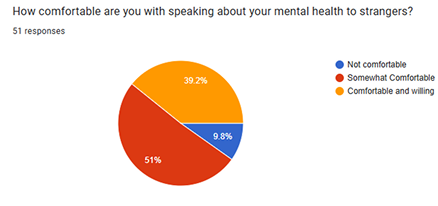

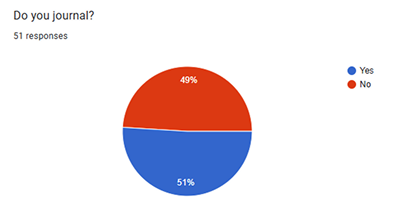
These results showed us that while people are deeply engaged with social media, many still hesitate to openly discuss their mental health, reinforcing the need for a platform that feels safe, private, and judgment-free. Seeing that users were more comfortable in semi-anonymous or reflective spaces like journaling and selective sharing pushed us to design MoodShare around personal reflection, controlled visibility, and community support rather than public broadcasting. This shifted our design thinking from “encouraging people to speak up” to “meeting people where they are emotionally,” shaping MoodShare into a tool that prioritizes trust, empathy, and gradual self-expression.
“I feel like there's a really big push, and there's a lot of advocacy, specifically towards the black community, on the importance of mental health and the consequences of not receiving mental health services to deal with various issues of trauma and crises.”
Interviews
“It bothers me. It’s hurtful to others when people don’t seek help — even though it’s uncomfortable."
“You’ve got to evolve with the tech—kids are getting phones earlier, accessing all kinds of apps. If we’re not keeping up, we’re missing what’s shaping their mental health.”
“Culture is the vehicle for understanding what’s normal and what’s not in mental health—but psychology often forgets that. We can’t use a one-size-fits-all lens for healing.”
Our research revealed several key insights that directly shaped MoodShare’s design and purpose:
Many users, especially from marginalized communities, avoid sharing openly due to stigma, lack of emotional safety, and fear of judgment.
Participants valued mental wellness tools that felt culturally responsive, empathetic, and grounded in real life rather than clinical or generic.
Existing social platforms were seen as inconsistent support spaces, often impacted by comparison, performative behavior, and weak moderation.
Users preferred flexible, low-pressure tools like journaling, reflection, and trusted peer conversations over rigid wellness systems.
There was strong demand for a platform centered on authenticity, safety, and community rather than visibility and engagement.
These insights guided MoodShare’s direction, shifting the focus toward building a trusted, emotionally safe space that supports self-awareness, meaningful connection, and long-term well-being.
Persona
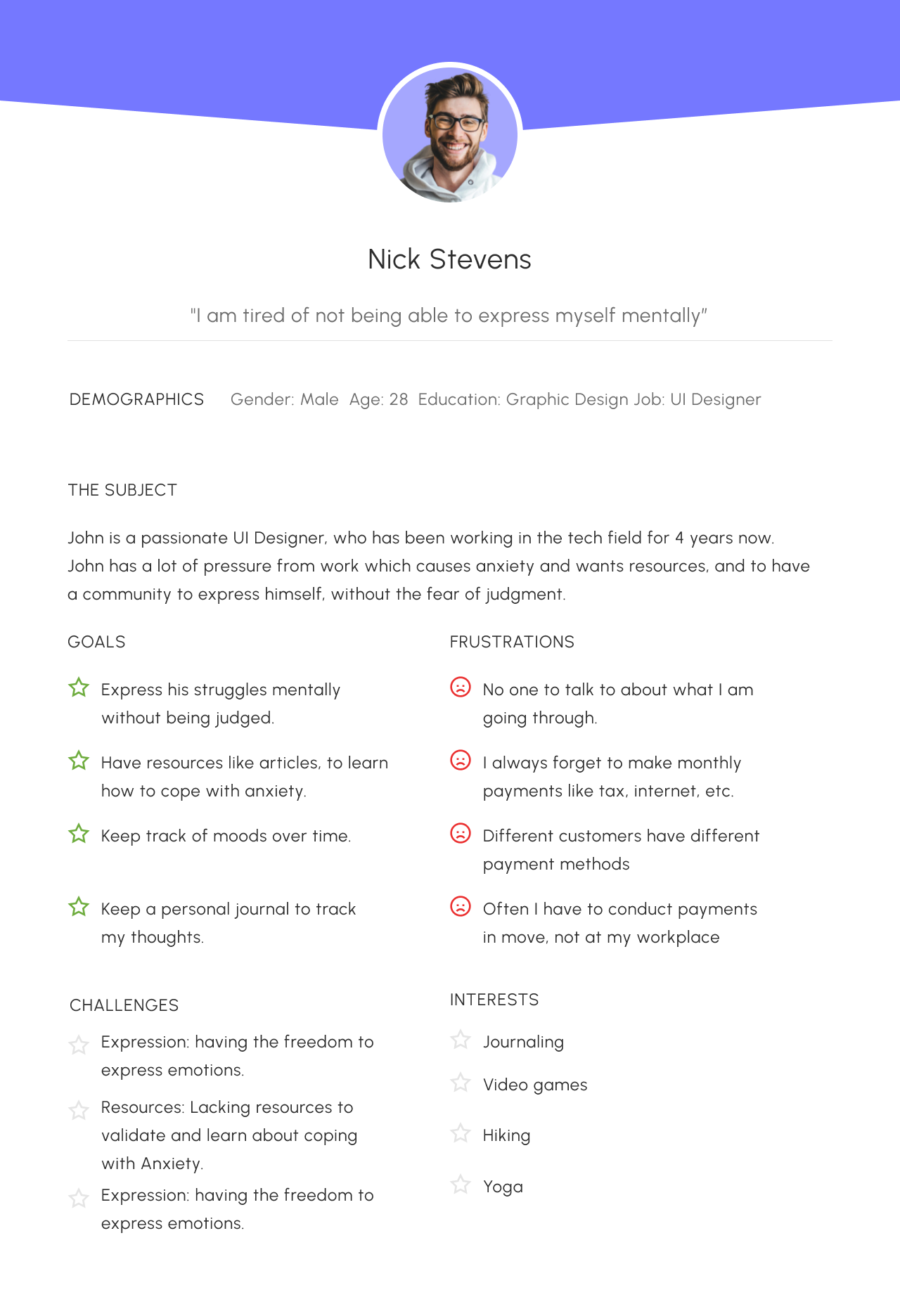
Building on our research insights, we translated recurring user needs, behaviors, and challenges into a relatable persona to guide our design decisions. Nick represents users who want a safe space to express themselves, manage anxiety, and track their mental health without fear of judgment, reflecting patterns we observed in interviews and surveys. As a UI designer navigating work pressure and limited emotional support, Nick helped us stay focused on designing features that prioritize reflection, accessibility, and community-centered support.
Wireframes
These early sketches were informed by research into how users navigate mental health apps and what makes them feel comfortable engaging consistently. We prioritized simplicity, clarity, and emotional safety across every screen.
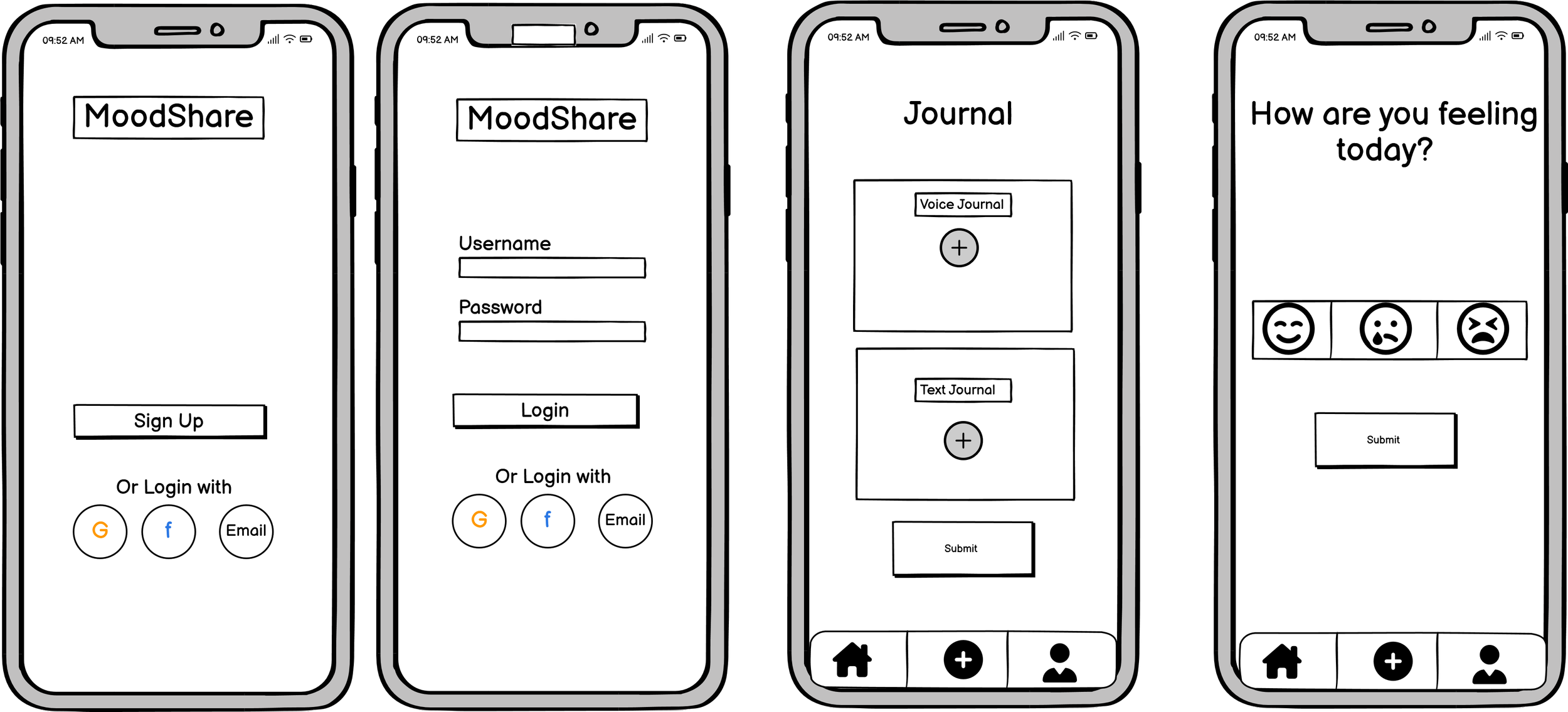
A streamlined sign-up and login flow to minimize drop-off.
Voice and text journaling for self-expression.
Quick mood check-ins to support daily emotional awareness.
Final Product
As the project moved from low-fidelity wireframes to high-fidelity prototypes, I focused on refining both usability and emotional experience. Each feature was enhanced to feel more intuitive, supportive, and aligned with MoodShare’s mission of promoting mental wellness.


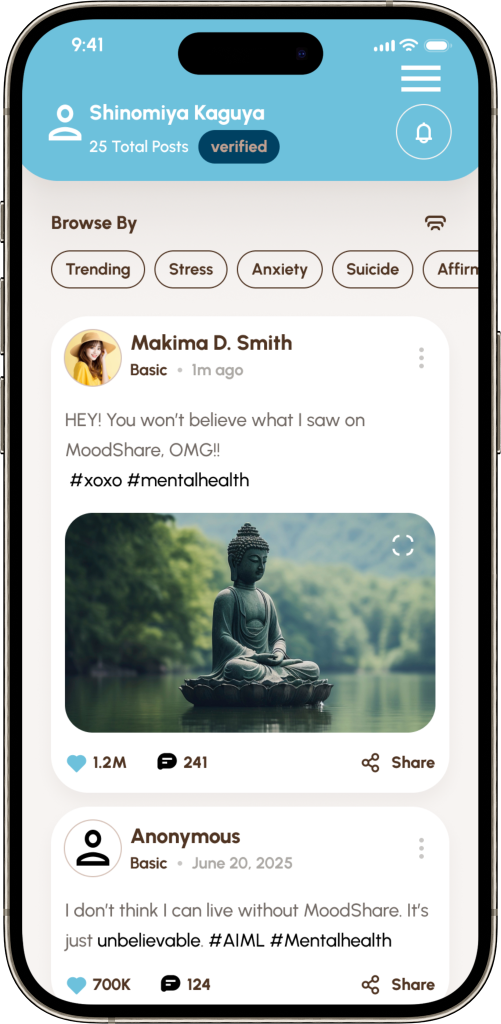
A redesigned Resources feed that highlights community posts, wellness content, and mental health tools.
Features

An interactive Mood Tracker that visualizes emotional patterns over time.
A mood history view to encourage reflection and self-awareness.
Lessons Learned & Future Thoughts
The future of MoodShare includes an expanded set of resources designed to support holistic mental wellness. This will feature mindfulness exercises, an integrated exercise tracker, and a sleep tracker to help users maintain balance in both body and mind. MoodShare also aims to strengthen its community through mental health fundraisers and events, while offering professional workshops and seminars to foster education, support, and connection.